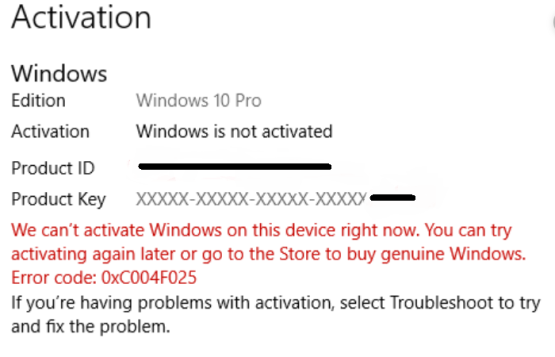
Windows Activation error 0xC004F025 is one of those deceptively simple errors that can quickly turn into a time-sink for IT teams. On the surface, it presents as an “Access Denied” issue during activation or licensing operations. In reality, it often exposes deeper problems related to user privilege boundaries, licensing state corruption, device identity changes, or enterprise activation workflows.
I’ve seen this error most frequently in:
- Post-imaging or MDT/SCCM deployments
- Azure AD / Hybrid-joined devices
- Systems upgraded in-place across Windows versions
- Machines touched by security hardening or GPO changes
This guide goes well beyond the usual “run slmgr as admin” advice and walks through why the error occurs, how to fix it properly, and how to prevent it in managed environments.

Execute slmgr.vbs –What Is Windows Activation Error 0xC004F025?
Error 0xC004F025 translates to:
Access denied: The requested action requires elevated privileges
At its core, Windows is blocking activation-related actions because the process lacks sufficient permissions. However, this does not always mean the logged-in user isn’t an admin — and that’s where many guides stop short.
Common Scenarios Where This Error Appears
- Running
slmgr.vbsorslmgr.vbs -rearm - Activating Windows via Settings
- Applying MAK or KMS keys
- Reactivating Windows after hardware changes
- Running activation scripts during automated deployment
Root Causes IT Pros Should Actually Care About
1. User Context vs Token Elevation (Most Common)
Being a member of the Administrators group is not the same as running an elevated process. UAC still enforces token separation, and activation APIs require full elevation.
Real-world example:
A domain admin logs in but launches PowerShell from Start instead of “Run as administrator” — activation fails.
2. Corrupted or Inconsistent Licensing Store
Windows stores licensing data in protected system locations. Failed upgrades, AV interference, or interrupted sysprep operations can leave the licensing store in a partially broken state.
Symptoms include:
- slmgr commands failing even when elevated
- Activation UI silently failing
- Event Viewer licensing errors
3. Hardware ID Mismatch (Especially Motherboard Changes)
Windows activation is tightly bound to a hardware hash, with the motherboard being the most significant component.
If the system:
- Had a motherboard replaced
- Was converted from physical to virtual (P2V)
- Had firmware/TPM changes
…Windows may refuse activation attempts until revalidated.
4. KMS / MAK Misalignment in Enterprise Environments
In corporate networks, activation failures often stem from:
- Incorrect KMS client keys
- DNS SRV record issues
- Devices unable to reach KMS hosts
- Mixing MAK and KMS licensing models
Error 0xC004F025 can surface when Windows attempts to execute licensing actions blocked by policy or misconfiguration.
5. Group Policy or Security Hardening
Some CIS baselines or security hardening scripts restrict access to:
- WMI licensing providers
- Software Protection Platform services
- Registry paths tied to activation
This is especially common on hardened servers.
Step-by-Step Fixes (From Basic to Advanced)
Step 1: Confirm True Administrative Elevation
Do not assume — verify.
- Open Command Prompt
- Right-click → Run as administrator
- Confirm UAC prompt appears
Then run:
whoami /groups
Ensure BUILTIN\Administrators shows Enabled.
Step 2: Reset License Status with slmgr.vbs (Properly)
The classic fix — but done correctly.
slmgr.vbs -rearm
Important Notes from the Field
- Rearm is limited (usually 3–5 times)
- Requires reboot after execution
- Will fail silently if not elevated
- On enterprise builds, rearm may be disabled by policy
After reboot, attempt activation again.
Step 3: Restart the Software Protection Service
Licensing operations depend on this service.
net stop sppsvc
net start sppsvc
If the service won’t start, check:
- Event Viewer → Applications and Services Logs → Microsoft → Windows → Security-SPP
This log is criminally underused in most guides.
Step 4: Use the Windows Activation Troubleshooter (Surprisingly Effective)
Navigate to:
Settings → Update & Security → Activation → Troubleshoot
This is particularly effective for:
- Digital licenses tied to Microsoft accounts
- Hardware changes
- Windows 10 → 11 upgrades
In practice, I’ve seen this tool succeed where manual slmgr commands fail — especially on Azure AD-joined devices.
Step 5: Reactivate After Hardware Change
If hardware was changed:
- Sign in with the Microsoft account originally used
- Run Activation Troubleshooter
- Select “I changed hardware on this device recently”
If using MAK:
slmgr.vbs /ipk XXXXX-XXXXX-XXXXX-XXXXX-XXXXX
slmgr.vbs /ato
Step 6: Validate KMS Configuration (Enterprise Environments)
Run:
slmgr.vbs /dlv
Check:
- License status
- Activation channel
- KMS server details
Then:
nslookup -type=srv _vlmcs._tcp
No SRV record = no activation.
Step 7: Check Group Policy and Security Restrictions
Look for policies affecting:
- Software Protection Platform
- WMI permissions
- Script execution
- Registry access
I’ve personally traced 0xC004F025 to:
- Overzealous endpoint protection
- Hardened server images
- Broken inherited GPOs
When All Else Fails
Option 1: Contact Microsoft Support
Especially recommended if:
- You have valid licensing
- Activation servers reject the request
- Digital license recovery fails
Option 2: Clean OS Reinstallation
Not ideal — but sometimes the fastest path when licensing state is irreparably broken.
Preventing Error 0xC004F025 in the Future
From real-world experience, here’s what actually helps:
- Standardise activation methods (don’t mix MAK/KMS randomly)
- Avoid unnecessary motherboard replacements without license planning
- Always elevate scripts in deployment pipelines
- Validate activation before handing devices to users
- Document licensing paths in build documentation (seriously)
Final Thoughts from the Field
Error 0xC004F025 isn’t just a permissions issue — it’s a symptom. In managed environments, it usually points to a breakdown between identity, licensing, and system state.
Treat it as a signal to:
- Audit your activation workflows
- Review privilege boundaries
- Tighten deployment consistency
Handled properly, it’s a quick fix. Handled blindly, it becomes a recurring operational headache.

From my early days on the helpdesk through roles as a service desk manager, systems administrator, and network engineer, I’ve spent more than 25 years in the IT world. As I transition into cyber security, my goal is to make tech a little less confusing by sharing what I’ve learned and helping others wherever I can.

Thank you very much to the writer for sharing the methods and step-by-step instructions for the activation of windows 10.