Windows 10 logo

In today’s IT environments, file availability and redundancy are critical to business continuity. Distributed File System (DFS) and DFS Replication (DFSR) are powerful Windows Server technologies designed to address these needs. They allow IT teams to unify multiple shared folders into a single logical namespace while keeping data synchronized across multiple servers, providing high availability, load balancing, and simplified disaster recovery.

Whether your organization runs a single office or a multi-branch enterprise, DFS ensures users can access files consistently without worrying about where they are physically stored. For IT professionals, understanding DFS architecture and its proper implementation is key to reducing downtime, streamlining file access, and improving administrative efficiency.


Understanding DFS Components

DFS consists of two main components that serve distinct purposes:

1. DFS Namespaces (DFSN)

DFS Namespaces allow you to create a logical structure of shared folders across multiple servers. Users see a single, unified folder tree, even though the underlying folders may reside on different servers. This abstraction simplifies file access and allows administrators to reorganize storage without impacting users.

2. DFS Replication (DFSR)

DFS Replication is a multi-master replication engine that keeps folders synchronized between servers. It uses Remote Differential Compression (RDC) to replicate only the changed portions of files, minimizing bandwidth consumption and ensuring efficient, near real-time replication.


Benefits of DFS and DFS Replication

Implementing DFS and DFSR delivers multiple operational advantages:

  • Centralized file access: Users access a single namespace, reducing confusion and support tickets.
  • High availability: Multiple servers host the same files, preventing single points of failure.
  • Load balancing: DFS can distribute access across servers, reducing strain on any one system.
  • Disaster recovery: Data replication across sites ensures continuity in case of hardware failure.
  • Bandwidth efficiency: RDC replicates only modified file segments, minimizing network load.

Pro Tip: DFS is especially effective in branch office scenarios, where users access a local copy of files, reducing WAN dependency while still maintaining centralized management.


Prerequisites for Implementing DFS

Before deploying DFS and DFSR, ensure your environment meets the following requirements:

  • Administrator privileges on all participating servers.
  • Two or more Windows Servers 2012 or later (DFS functionality is supported on newer versions).
  • Active Directory domain membership for all DFS servers.
  • Reliable network bandwidth between servers.
  • Correct DNS resolution and time synchronization to prevent replication issues.

Real-World Insight: Time discrepancies as small as five minutes can break DFS replication, making NTP configuration critical in multi-site deployments.


How to set up a DFS Namespace

Step 1

Install DFS Roles

On each server that will participate in DFS:

  1. Open Server Manager.
  2. Click on Manage > Add Roles and Features.
  3. Proceed through the wizard until you reach the Server Roles screen.
  4. Under File and Storage Services > File and iSCSI Services, select:
    • DFS Namespaces
    • DFS Replication
  5. Complete the wizard and restart if prompted.

Step 2

If you would like to use DFS you will need to Install the DFS Namespaces and DFS replication server roles. You can do this through Server Manager.  

Select Manage and then Add Roles and Features     

Please note : On Server2 you do not necessarily need to install DFS Nampespaces. Just DFS Replication will do and the files will successfully replicate to this server.

DFS replication

Create a identical folder on each server and Share this folder

Open your DFS Management console and create a Name space.

DFS new name space

New Namespace

Type in the server name that you are setting the DFS share

Namespace wizard

Give your Namespace a name.  (This is not your share name)

DFS replication wizard

Your names space will then be created.

Set up the DFS share that you will replicate.

Right click on your name space and select Add new folder

dfs managment

Point to the new Shared folder that will be used in DFS and give it a name.

DFS folder

Step 3

How to set up DFS Replication

There is no need to log into your second server. Now that you have set up your DFS folder you can now replicate this folder with the folder on your second DC that you created in step 1 straight from the management console on server 1

You can do this by adding a new Folder Target which points to your second server’s share.

DFS target
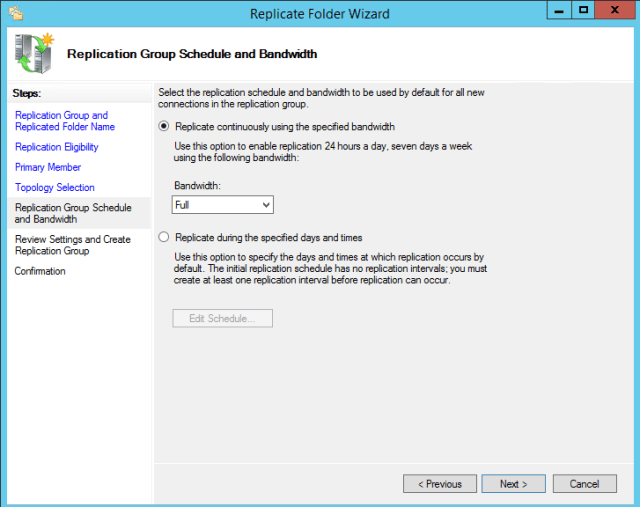
Replicate folder wizard
DFS folder wizard
dfs folder replication
DFS folder replication wizard
DFS replication wizard

Verify Replication

  1. Use the DFSR Event Logs to monitor replication status.
  2. Run the following command to check replication health: dfsrdiag ReplicationState
  3. You can also use DFS Management > Replicated Folders to review replication groups and health.

Troubleshooting Common DFS Issues

Even experienced IT pros encounter DFS issues. Key troubleshooting steps include:

  • Firewall and network checks: Ensure RPC and DFS-related ports (TCP 135, 139, 445) are open.
  • Time synchronization issues: Confirm NTP is consistent across all servers.
  • Backlog evaluation: Use dfsrdiag backlog to identify delayed file replication.
  • Active Directory replication: DFS relies on AD; unresolved AD issues can prevent folder targets from appearing.
  • Replication group validation: Check Event Viewer for errors related to staging folders, permissions, or file conflicts.

Pro Insight: Many replication failures are due to misconfigured permissions or NTFS ownership rather than network problems. Always verify ACL consistency across servers.


Advanced Tips for Enterprise Deployments

  • Multi-site DFS: Use site-specific targets to optimize access and replication efficiency.
  • Load balancing DFS referrals: Configure target priority and referral ordering to distribute user requests efficiently.
  • Monitoring replication latency: Set up automated alerts for replication backlog thresholds to prevent data lag in multi-site setups.
  • Use DFS for branch office resilience: Implement read-only replicas at branch sites to improve user experience and reduce WAN dependency.

Conclusion

DFS and DFS Replication are essential tools for IT professionals seeking high availability, scalable file access, and simplified file management across Windows Server environments.

By following this guide—covering role installation, namespace creation, folder replication, best practices, and troubleshooting—administrators can implement a DFS solution that:

  • Provides a unified namespace for users
  • Ensures synchronized and fault-tolerant file access
  • Optimizes network bandwidth and reduces administrative overhead
  • Improves disaster recovery and redundancy

Final Advice: Treat DFS not just as a replication tool but as part of your overall IT resilience strategy. Regular monitoring, proper planning, and adherence to best practices will prevent replication issues and keep your organization’s file services running smoothly.de, you can ensure your organisation benefits from a unified namespace and consistent file replication, making file management both simple and secure.

Leave a Reply

Your email address will not be published. Required fields are marked *