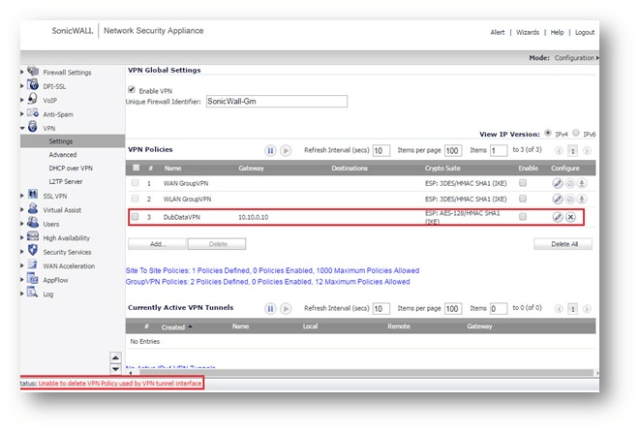
If you manage SonicWall firewalls long enough, you’ll eventually hit an error that feels unnecessarily stubborn. One of the more frustrating ones is when you attempt to delete a VPN policy and SonicWall throws the message:
“Error: Index of the interface: Interface is in use by OSPF”
At first glance, this seems odd — especially if the VPN is no longer active, the tunnel is down, or the remote site was decommissioned months ago. Yet SonicWall flatly refuses to remove the VPN policy.
This isn’t a bug. It’s SonicWall doing exactly what it was designed to do — protecting routing integrity. Unfortunately, the UI doesn’t always make the dependency chain obvious, which is why this issue regularly wastes time in production environments.
This article explains why the error occurs, what SonicWall is protecting you from, and how to cleanly and safely remove a VPN policy tied to OSPF without breaking your routing table.

Understanding the Root Cause: VPNs, Interfaces, and OSPF
Why SonicWall Won’t Let You Delete the VPN
In SonicWall, VPN policies are not just tunnels — they create logical VPN interfaces. When you enable Advanced Routing and configure OSPF, those VPN interfaces can be used as OSPF-enabled links.
Once that happens:
- The VPN interface becomes part of the routing topology
- OSPF may advertise routes across the tunnel
- SonicWall locks the interface to prevent accidental routing outages
From SonicWall’s perspective, deleting the VPN without removing OSPF would:
- Break adjacency relationships
- Potentially blackhole routes
- Cause unpredictable routing behaviour
So the firewall blocks you — loudly.
Common Real-World Scenarios Where This Happens
From field experience, this error usually appears in one of these situations:
- A site-to-site VPN was retired but OSPF was forgotten
- A temporary VPN became permanent and routing dependencies grew
- A network redesign removed dynamic routing, but not its bindings
- An admin inherited a firewall with undocumented routing configs
- A failed VPN migration left stale interfaces behind
In all cases, the fix is the same: remove dependencies in the correct order.
The Correct Way to Delete a SonicWall VPN Policy Using OSPF
⚠️ Important Warning Before You Start
If this VPN is part of a live routing topology, removing it will impact traffic. Before proceeding:
- Confirm the VPN is no longer required
- Check routing tables for dependencies
- If possible, perform changes in a maintenance window
- Export your SonicWall configuration as a backup
Step-by-Step Solution
Step 1: Enable Advanced Routing (If Not Already Enabled)
- Navigate to:
Network → Routing - Under Routing Mode, select:
Advanced Routing - Apply changes if prompted
🔎 Why this matters: OSPF configuration is only visible in Advanced Routing mode. Many admins miss this step and assume OSPF isn’t enabled when it actually is.
Step 2: Disable OSPF on the VPN Interface
- Still under Network → Routing
- Locate Routing Protocols
- Find the OSPF configuration associated with the VPN interface
- Click Configure OSPF (radio button or edit icon)
- Disable OSPFv2 for that interface
- Apply changes
💡 Expert tip: Don’t just disable globally — ensure the specific VPN interface is no longer participating in OSPF.
At this point, SonicWall releases the routing lock on the VPN interface.


Step 3: Delete the VPN Interface
Now that OSPF is no longer using the interface:
- Go to:
Network → Interfaces - Locate the VPN Interface associated with the policy
- Select it and click Delete
- Confirm the deletion
If OSPF was correctly removed, this step should now succeed without errors.
Step 4: Delete the VPN Policy
With both routing and interface dependencies gone:
- Navigate to:
VPN → Settings - Locate the VPN policy you originally attempted to delete
- Click Delete
- Confirm removal
The VPN policy should now delete cleanly.
Why the Order Matters (And Why SonicWall Is Right)
The deletion order is critical:
- OSPF dependency
- VPN interface
- VPN policy
Attempting this in reverse order will always fail.
From an architectural standpoint, SonicWall is enforcing a dependency graph, not just a UI restriction. This design prevents outages caused by accidentally deleting infrastructure still in use — a surprisingly common mistake in enterprise networks.
Troubleshooting If It Still Won’t Delete
If you still can’t delete the VPN after following the steps above, check:
- Multiple OSPF areas referencing the same interface
- Static routes bound to the VPN interface
- Virtual routing instances (VRF-like behaviour)
- High Availability (HA) sync issues
- Pending configuration changes not yet applied
In stubborn cases, a reboot after removing OSPF (with config saved) can clear cached dependencies — though this should be a last resort.
Real-World Advice: Avoiding This in the Future
From operational experience, here are a few best practices:
- Document routing dependencies when enabling OSPF on VPNs
- Use naming conventions that indicate routing participation
- Periodically audit OSPF-enabled interfaces
- Disable OSPF before decommissioning VPNs
- Avoid “temporary” VPNs becoming permanent without review
Dynamic routing is powerful — but it increases configuration coupling. SonicWall is unforgiving if you don’t unwind that coupling cleanly.
Final Thoughts
The “Interface is in use by OSPF” error isn’t a bug — it’s SonicWall protecting your network from accidental self-inflicted outages. Once you understand how VPN interfaces, OSPF, and routing dependencies interact, the fix becomes logical and repeatable.
For experienced network administrators, this is one of those issues that reinforces an old truth:
Firewalls don’t forget dependencies — even when humans do.
Handled correctly, deleting a SonicWall VPN tied to OSPF is straightforward, safe, and predictable.

From my early days on the helpdesk through roles as a service desk manager, systems administrator, and network engineer, I’ve spent more than 25 years in the IT world. As I transition into cyber security, my goal is to make tech a little less confusing by sharing what I’ve learned and helping others wherever I can.